
Symbolic Systems Curriculum
A self-study path through minds, language, logic, computation, and AI—with eight modules, readings, and exercises.
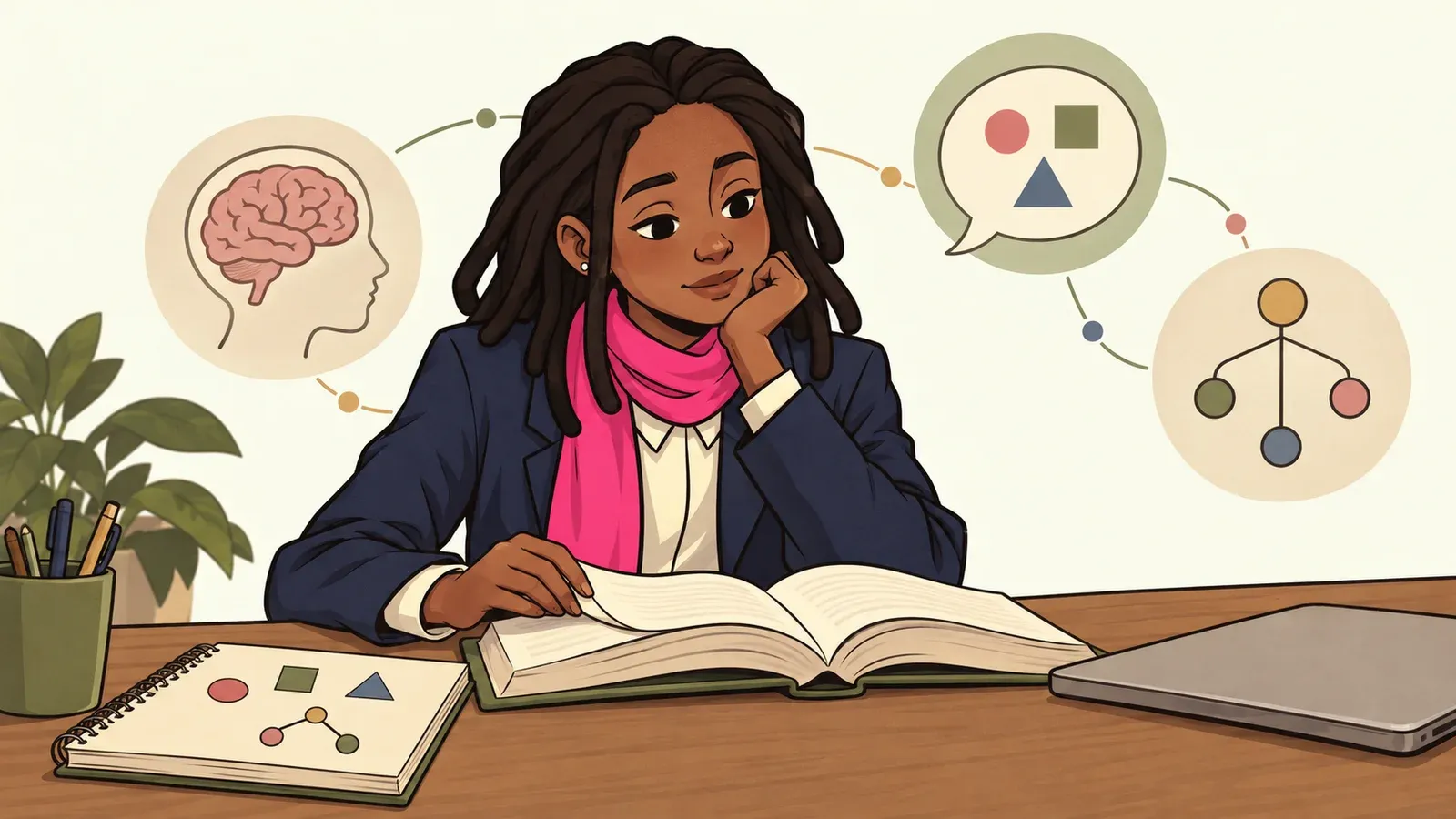
Open a section and start anywhere.
Why I’m studying this
I’ve loved computer science since the eighth grade. The magic pill for me was hacker movies, specifically Anonymous. I thought it was so cool that there were machines that influenced the world that we could deterministically influence. By being able to work with these machines, we could create something in the machines and therefore create something in the real world. As I grew and learned more about the world outside of machines, I’ve always wanted a more complete understanding of how the world works, especially where psychology and technology meet.
The more I’ve learned, the more I’ve started to think of human beings as systems, too. We have psychological patterns and mental models, shaped by our bodies, our environments, and much more. Learning about psychology soon led me into philosophy: what does it mean to have a mind, a soul, a psyche? I’ve gone down Carl Jung rabbit holes, including his ideas about the shadow, and encountered so many different ways of explaining ourselves. I want to understand how these models relate, where they disagree, and what they help us see.
Symbolic systems feels like a good starting point for that integrated understanding. I want to understand the world because understanding gives us more ways to make a difference.
One idea I kept taking away from Gödel, Escher, Bach, is that the process of changing a system starts with understanding how it works. In a formal system, that means understanding its axioms and rules of inference before asking what can be derived within it. That’s also the question I’m carrying into this study: what is possible, and what would have to change to produce a different outcome?
This curriculum begins with five resources Michael C. Frank recommended for self-study, alongside selected open materials and inspiration from Stanford’s Symbolic Systems curriculum. I’m putting them together to connect the ideas, test my understanding, and learn how to make changes more intentionally.
What symbolic systems brings together
As Stanford’s program description explains, symbolic systems studies natural and artificial systems that represent and process information. Its core requirements bring philosophical, formal, computational, and empirical approaches together. That combination is the useful part to borrow: arguments about minds belong beside logic, programs, and observations of actual people.
This is an independent self-study plan inspired by that structure. It is not a Stanford-endorsed curriculum or a substitute for the degree. I’ve chosen a smaller set of questions, readings, and exercises that work outside a university classroom.
The five recommendations from Michael C Frank
Gödel, Escher, Bach: An Eternal Golden Braid, by Douglas R. Hofstadter.
The Scientist in the Crib: What Early Learning Tells Us About the Mind, by Alison Gopnik, Andrew N. Meltzoff, and Patricia K. Kuhl.
Artificial Intelligence: A Guide for Thinking Humans, by Melanie Mitchell.
Experimentology: An Open Science Approach to Experimental Psychology Methods, by Michael C. Frank and colleagues.
The Open Encyclopedia of Cognitive Science, from MIT Press.
The first three are books you can borrow, buy, or obtain. however you want 👀. The final two are free online. If you want a free-first route, start with the open readings and lectures below while you arrange access to the books.
How to use this plan
Allow roughly 12 to 16 weeks for a first pass, perhaps three to five hours a week. That is a flexible planning estimate, not a deadline or a promise that every topic will fit. The assignments use selected readings and lectures; they do not require finishing every book or completing entire university courses.
Keep one notebook. After each module, save the exercise, a plain-language explanation of the main idea, and one question you still cannot answer. Definitions earn their place when you can use them. If you can say “representation” but cannot explain what a map leaves out, spend another afternoon with maps.
Read in order for the first pass. Take extra time with a difficult module, and let Gödel, Escher, Bach run alongside the others at its own pace.
An optional foundations detour
You can begin without coding. For a technical on-ramp, use lectures 1, 2, and 4 in MIT’s free Introduction to Computer Science and Programming in Python: computation, branching and iteration, then functions and abstraction. The course is older; use these lessons for the concepts.
For mathematics, review sets, functions, and basic algebra as needed. 3Blue1Brown’s introduction to vectors is an optional visual starting point before neural networks. You do not need calculus to do the exercises here. Paper, a spreadsheet, or a few lines of code are all acceptable ways to make a model explicit.
1 Representation and formal systems
Big question: What does it mean for one thing to stand for another?
Read: Start with the opening discussion of formal systems in Gödel, Escher, Bach. Pair it with the encyclopedia entry Mental Representation. Focus on the difference between a mark, the rules for manipulating it, and what someone takes it to mean.
Do: Represent a familiar activity, such as ordering coffee, in two ways: a short paragraph and a tiny rule system. Give the rule system a fixed vocabulary and explicit rules. Then try an awkward request: “the usual,” “something less sweet,” or an order with a missing detail. Record what each representation handles easily and what it leaves out. You can write the rules on paper; no programming is required.
Learning outcome: Identify a system’s symbols and operations, and explain why a useful representation may still omit important context. Keep one unresolved example. It will be useful when language enters the picture.
2 Logic and good arguments
Big question: When does a conclusion actually follow from its premises?
Read: Use Stanford’s open Introduction to Logic, beginning with Introduction, Propositional Logic, and Propositional Analysis. Try Direct Proofs if those feel comfortable. Treat the exercises as the main event; reading a proof and producing one are different skills.
Do: Choose three claims from an ordinary decision, such as whether a café will be open. Write them as simple propositions. Make a truth table for one conditional claim, then test whether a proposed conclusion follows. Invent a counterexample to a tempting but invalid inference. Finally, check the premises against the world: perhaps the café changed its hours.
Learning outcome: Distinguish a valid argument from an argument whose premises are true, and explain why logic alone cannot establish the opening hours of a café. The formal structure and the factual evidence each have a job.
3 Computation and abstraction
Big question: What changes when an idea becomes an executable procedure?
Read or watch: Use MIT’s Python lecture collection, especially lecture 4 on functions and abstraction and lecture 6 on recursion. If programming is new, start with the foundations detour. Return to a passage on recursion or self-reference in Gödel, Escher, Bach.
Do: Write precise instructions for finding a name in an alphabetized list. First check names one by one. Then repeatedly discard half the remaining list. Trace both methods by hand on a list of sixteen names, including a search for a name that is absent. Count comparisons and state the assumptions your faster method needs. Optional code should reproduce your hand-worked examples before you try a larger list.
Learning outcome: Separate a problem from an algorithm for solving it, explain an abstraction, and compare two procedures. Add a question for later study: how would you investigate whether some tasks have no algorithmic solution at all?
Optional infinity extension: Read chapter 13, Infinite Sets, from MIT’s Mathematics for Computer Science. Pair each positive whole number with a positive even number. Explain how the sets can have the same size even though one sits inside the other. Then use the chapter’s treatment of diagonal arguments to explain why no list can contain every infinite binary sequence. Keep mathematical results separate from larger claims about minds.
4 Minds brains and growing up
Big question: How can a biological learner acquire knowledge from limited experience?
Read or watch: Read a section of The Scientist in the Crib on early learning. Pair it with Causal Learning in the encyclopedia. For a biological foundation, watch MIT’s Brain I lecture on brain structure and function.
Do: Design a fictional learning problem with a box that lights up when certain blocks touch it. List two possible explanations for how the box works. Invent observations compatible with both, then choose an intervention that would distinguish them. Describe what a learner would have to perceive, remember, and physically do. This is a thought experiment, not a request to experiment on children.
Learning outcome: Explain the difference between noticing an association and testing a cause, while naming biological and developmental questions your toy model leaves unanswered. A rule about blocks does not yet explain how a nervous system learns that rule.
Optional philosophy bridge: Read The Mind-Body Problem. Write a short argument about what a brain-level explanation of an experience would explain and what remains disputed. Include the strongest objection to your argument.
5 Language and meaning
Big question: How do people understand sentences they have never encountered before?
Read: Pair the encyclopedia entries Language and Compositionality. Focus on how the meanings of parts and their arrangement contribute to a sentence’s meaning, then notice where context complicates the picture.
Do: Write a tiny grammar that generates ten sentences from a small vocabulary. Change a word or its position and describe the effect. Include “The dog chased the cat” and “The cat chased the dog.” Then try a sentence whose intention depends on context, such as “Can you open the window?” Separate its grammatical form from what a speaker might be asking someone to do. Revisit the difficult coffee order from module 1.
Learning outcome: Explain compositionality with an example and distinguish grammar, meaning, and context. Keep track of what your grammar can generate without assuming that generation demonstrates understanding.
6 Probability and testing ideas
Big question: What evidence should make us change our minds?
Read: In Experimentology, start with chapters 1 and 2 on experiments and theories, then read chapter 8 on measurement and chapter 9 on design. Skim ethics in chapter 4 and preregistration in chapter 11. For probability, use this free introduction to Bayes’ rule.
Do: Imagine choosing between two bags of tokens. Bag A has eight red and two blue; bag B has two red and eight blue. You choose a bag with equal probability, then draw one red token. Work out how the observation changes the odds of having chosen A. Next, draft a one-page plan for a hypothetical memory study. Define exactly what “remembering better” would mean, one comparison, and one alternative explanation. Do not collect personal data for this exercise.
Learning outcome: Update a simple belief from evidence and distinguish an appealing hypothesis from a measurable research question. The token answer is an 80 percent probability of bag A; explain why, rather than memorizing it.
7 Artificial intelligence and understanding
Big question: What would count as evidence that an AI system understands something?
Read: In Mitchell’s Artificial Intelligence: A Guide for Thinking Humans, focus on chapter 14, “On Understanding,” and chapter 15, “Knowledge, Abstraction, and Analogy in Artificial Intelligence.” If AI is new to you, start with chapters 1 and 2 on its roots and neural networks. Add the encyclopedia entry AI Model Evaluation for a framework for thinking about tests.
Do: Build ten examples for a narrow task, such as identifying who owns an object in a short story. Write expected answers and a scoring rule before testing anything. Include a paraphrase, an irrelevant detail, and a case where the story does not provide enough information. If you have access to an AI system, record its name and version, the date, and the exact prompts. Otherwise, evaluate a simple rule-based solution you write yourself.
Learning outcome: Describe what your test measures and what it cannot establish. Ten examples can expose a failure; they cannot settle whether a system understands language in general. Use observed errors to propose a better next test.
Guided reading of Attention Is All You Need
I’m adding Attention Is All You Need by Ashish Vaswani and colleagues (2017) to this curriculum; it is separate from Frank’s five suggestions. The paper introduced the Transformer, with experiments on machine translation.
Read in passes: Start with the abstract and introduction, then use Figure 1 as a map while reading section 3. Focus on attention in 3.2, token embeddings in 3.4, and positional encoding in 3.5. Ask what each component contributes before worrying about every equation.
The symbolic systems connection: This brings language, representation, computation, and learning into one concrete example. Discrete tokens become learned continuous vectors; attention combines information across positions to build contextual representations. Compare that with explicit rules for manipulating symbols in the earlier modules. Symbolic Systems is the broader field, not just rule-based symbolic AI. Here, “attention” names a computational operation, not psychological awareness or evidence of consciousness.
Do: Compare “She waited by the bank for the boat” with “She waited by the bank for a loan.” Underline the context that changes your interpretation of “bank.” Treat words as tokens for this sketch, noting that actual tokenization can split words. Draw which positions you would connect to represent the difference. Label this a hand-built hypothesis, not a measured attention map; even measured weights alone would not establish understanding.
Optional math: Revisit vectors and matrix multiplication, then trace section 3.2.1: compare queries with keys, scale the scores, apply softmax, and use the resulting weights to combine values.
Learning outcome: Explain how a Transformer represents context, then name one question about meaning that its architecture alone cannot answer.
8 Bring the explanations together
Big question: Can several explanations describe the same intelligent behavior without becoming interchangeable?
Read: Use the encyclopedia entry Levels of Analysis to distinguish what a system accomplishes, the representations and procedures it uses, and its physical implementation. Return to one earlier reading that now seems different.
Do: Make a small capstone about a familiar behavior: recognizing a friend, understanding a joke, or learning a new word. Write 800 to 1,200 words, or make a five-minute explanation. State the question, show a diagram or toy model, and connect at least three modules. Include one relevant observation from your reading, one testable prediction, and one limitation. Cite your sources and label invented examples clearly. A coded demonstration is optional.
Learning outcome: Explain a phenomenon at more than one level without pretending that a program, a psychological theory, and a description of brain activity answer exactly the same question. End with the next piece of evidence you would want.
What counts as progress
A finished reading list is satisfying, but the notebook is the better check. Can you explain a concept without borrowing the author’s phrasing? Can you build an example, find a counterexample, or say what evidence would change your view?
My starting point is a computer science background and a book I’ve now finished reading. I want a more integrated understanding of minds and technology, and of how understanding a system can help us change it. After a first pass, choose the question that remains most interesting and follow it more deeply. The next reading should earn its place by helping you answer it.
The Gen Z Guide to Symbolic Systems
This curriculum is the starting point for something I want to build as I learn: The Gen Z Guide to Symbolic Systems. Now that I’ve finished Gödel, Escher, Bach, I’ll be writing recaps of it and continuing with the other resources here. I’ll share the ideas I’m learning and how they connect. Over time, I want to bring those pieces together into my own accessible guide to symbolic systems.
I’m still learning, and the guide will grow along with that understanding. I’m considering an updates list for anyone who wants to follow along as I add new pieces.
Discussion
What are you thinking?
Opening your profile…
0 comments
No comments yet. You could be the first person with an opinion, which has never stopped the internet before.
For more from Michelle’s Computer, join the magazine waitlist ↗.